
Ask any final-year PU student in Karnataka about scholarships and one term comes up almost immediately: SSP. Short for the State Scholarship Portal, it’s the government’s online system for pre-matric and post-matric scholarships, and this year’s applications — the SSP Scholarship 2026 cycle — are what a lot of families are trying to make sense of right now. Lakhs of students from SC, ST, OBC, minority, and EWS backgrounds go through this portal every year for help with tuition, hostel fees, and other academic costs.
Table of Contents
So here’s what we’ll cover: who qualifies, which documents to keep ready, how registration and login actually work, and how to track your application once it’s in the system. We’ve also written a broader piece on Karnataka Scholarship 2026 if SSP isn’t the only scheme you’re considering.
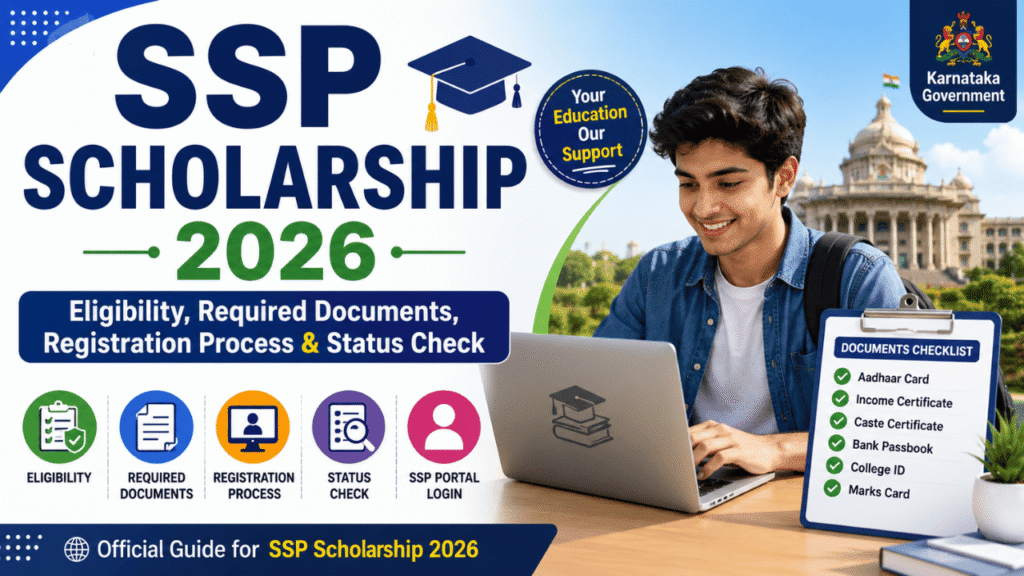
What is SSP Scholarship 2026?
Before SSP came along, students had to run between different department offices depending on their category and course — one window for SC scholarships, another for minority schemes, and so on. It wasn’t efficient, and a lot of genuine applicants fell through the cracks simply because paperwork got lost between offices.
The State Scholarship Portal fixed that by putting everything under one roof. It’s run by Karnataka’s Centre for e-Governance, working with departments like Social Welfare, Backward Classes Welfare, Minority Welfare, and Tribal Welfare. Each department still owns its scholarship schemes and decides who qualifies, but students only need one SSP account to reach all of them.
What does that mean in practice? Tuition fee reimbursement, a maintenance allowance in many schemes, and occasionally a one-time grant for books or equipment. Money moves straight into your bank account through Direct Benefit Transfer, so there’s no cheque to collect and no office visit required once your application clears verification.
Think of SSP as a single front door with many rooms behind it. You knock once, register once, and from there you can apply to whichever scheme fits your category and course.
SSP Scholarship 2026 Highlights
| Detail | Information |
|---|---|
| Scholarship Name | SSP Scholarship (State Scholarship Portal) |
| State | Karnataka |
| Portal Name | SSP – State Scholarship Portal |
| Official Website | ssp.karnataka.gov.in |
| Academic Year | 2026–27 |
| Application Mode | Online only |
| Status Check | Available on SSP dashboard after login |
| Login Availability | Separate login for Pre-Matric and Post-Matric students |
Based on the latest available SSP Portal guidelines, applications for 2026–27 are open for most departments already, though a handful open their windows in stages rather than all at once. We’ll update this page as soon as the Karnataka Government issues further notifications.
SSP Scholarship 2026 Eligibility
Here’s the thing students get wrong most often: they assume one scholarship’s rules apply to all of them. They don’t. Eligibility shifts depending on your education level, your category, and which department is actually funding that particular scheme.
For Pre-Matric students, meaning Classes 1 through 10, you need to be a permanent Karnataka resident, enrolled in a recognised school, with family income under the limit set for your category. Most Pre-Matric schemes also want your SATS ID, since that’s what links your school record to the scholarship system.
Post-Matric covers everyone after Class 10 — PUC, degree, diploma, professional courses. The core requirement is enrolment in a recognised Karnataka institution plus meeting whatever income and category conditions apply to your specific scheme.
SC students fall under Social Welfare Department schemes, generally with higher income ceilings than the general category, since these are meant to support communities that have historically had less access to education funding. ST students go through the Tribal Welfare Department instead, following a broadly similar structure but administered as its own track.
OBC applicants come under Backward Classes Welfare, and it’s worth knowing the income ceiling here tends to be tighter than SC/ST limits — don’t assume you qualify just because a friend in a different category did. Minority students are handled through Minority Welfare, and in most cases you’ll need to complete One-Time Registration on the National Scholarship Portal first and get an NSP ID before SSP will even accept your application.
EWS applicants need an EWS certificate plus proof they don’t already fall under an existing reservation category. And if you’re in a professional course — engineering, medicine, law — you’ll typically apply as Post-Matric, though some professional programs carry their own income and merit conditions on top of the usual rules, so read the specific scheme notification rather than assuming.
Required Documents
| Document | Purpose |
|---|---|
| Aadhaar Card | Identity verification and bank account linking |
| Income Certificate | Confirms your family falls within the eligible income bracket |
| Caste Certificate | Required for SC, ST, OBC, and minority category schemes |
| Bank Passbook | Needed for Direct Benefit Transfer of scholarship funds |
| College/School ID | Confirms your current enrolment |
| Fee Receipt | Proof of fees paid, used for reimbursement schemes |
| Marks Card | Previous year’s academic record, sometimes used for merit-based schemes |
| Mobile Number | For OTP verification and SMS updates |
| Email ID | For account creation and status notifications |
| Passport-size Photo | Uploaded during registration for your profile |
Scan everything before you start the form, not halfway through it — that’s the fastest way to avoid a session timeout wiping your progress. And keep an eye out for extras: a few departments also ask for a domicile certificate or a bonafide letter from your institution, depending on the scheme.
How to Register on SSP Portal
- Head to ssp.karnataka.gov.in — double-check it’s the actual government domain, since lookalike sites do exist.
- Pick your applicant type, Pre-Matric or Post-Matric. The portal routes you into different registration flows depending on this choice.
- Click “Create Account” and enter your basic details: name, date of birth, mobile number, email address.
- Verify both your mobile number and email through the OTPs sent to each.
- Enter your Aadhaar number. This step trips up a surprising number of applicants — the name on Aadhaar has to match your school or college records exactly, or the system flags it.
- Link your bank account, since this is where the scholarship amount eventually lands.
- If you’re a school student, add your SATS ID so your academic record connects to the application.
- Set a password and write down your login ID somewhere you won’t lose it.
- Submit. You’ll get a confirmation, and from there you can log in and start the actual scholarship application.
Go slow on the Aadhaar and name-matching step in particular. A large share of rejected applications trace straight back to a spelling mismatch nobody caught in time.
SSP Login Process
Once you’re registered, getting back in takes a minute.
- Go to ssp.karnataka.gov.in and pick the correct login — Pre-Matric and Post-Matric are separate portals with separate credentials.
- Enter your registered user ID or Aadhaar-linked ID.
- Enter your password.
- Complete the captcha.
- Click “Login” and you’re on your dashboard.
Forgotten your password? Use “Forgot Password” and verify via the OTP sent to your registered number. One thing to avoid: creating a second account because login isn’t working. Duplicate accounts almost always slow things down rather than fix them.
How to Apply for SSP Scholarship 2026
Quick version: log in, pick your scheme, fill in personal, academic, and bank details, upload documents, submit before the deadline, and note your application number for tracking later.
The longer version looks like this. After logging in, select the exact scholarship scheme matching your category and course — not just any scheme that seems close. The form asks for personal details, academic information like institution name and year of study, and family income. Upload scanned documents in the format specified (usually PDF or JPEG), and keep file sizes reasonable so uploads don’t fail.
Read through every section before hitting submit. Most schemes lock the form once it’s final, so there’s no going back to fix a typo afterward. Once submitted, your application goes to your institution for verification first, then to the department for approval.
Hold on to your application number. You’ll need it the moment you want to check where things stand.
How to Check SSP Scholarship Status
Quick version: log in to your SSP dashboard, open “Application Status” or “Student Status Report,” and enter your application number or SATS ID to see whether it’s pending, approved, or sent back for correction.
Step by step, it looks like this:
- Log in at ssp.karnataka.gov.in.
- Find the “Status” or “Track Application” section on your dashboard.
- Enter your application ID or SATS ID if the system asks for it.
- You’ll see your current stage — institution verification, department approval, or payment processing.
- If payment has gone through, the status usually shows the transaction date and amount credited.
Don’t refresh this every single day. Status changes depend on your institution and the concerned department clearing their part of the process, and during peak season that can genuinely take a few weeks.
Common Reasons for Application Rejection
- Name mismatch between Aadhaar, school records, and bank account — this is the single most common cause.
- Income certificate that’s outdated or doesn’t match the required financial year.
- Bank account not Aadhaar-linked, which blocks the Direct Benefit Transfer entirely.
- Missing SATS ID for school-level applicants.
- Blurry or partial document uploads that verifiers simply can’t read.
- Applying under the wrong scheme — a post-matric student accidentally using a pre-matric form, for instance.
- Institution delays in verification, which can cause an application to lapse through no fault of the student.
- Duplicate accounts created after a failed login attempt, which confuse the system rather than fix anything.
Most of this is preventable. A careful first pass through your documents saves a lot of back-and-forth later.
Benefits of SSP Scholarship
It’s not only about tuition relief, though that’s the headline benefit. Depending on the scheme, students can also get a maintenance allowance covering books, transport, and other day-to-day academic costs, along with hostel or accommodation support if they’re studying away from home. Because disbursement runs through direct bank transfer, there’s no waiting on a physical process to catch up. And support can continue year after year, provided you renew your application and keep meeting the eligibility conditions each cycle.
For a lot of first-generation college students across Karnataka, this is genuinely the difference between finishing a degree and having to drop out midway.
Important Dates
The SSP Scholarship 2026–27 application process is underway. Since each scholarship department follows its own schedule, the deadlines vary. Refer to the table below for the latest department-wise application dates.
| Event | Date / Status |
|---|---|
| Application Start | Applications are open (varies by department) |
| Backward Classes Welfare Department (Post-Matric) | 31 August 2026 |
| Tribal Welfare Department (Post-Matric) | 31 August 2026 |
| Minority Welfare Department | 30 September 2026 |
| Social Welfare Department (Post-Matric) | 31 January 2027 |
| Pre-Matric Scholarships (Most Departments) | 30 September 2026 |
| Scholarship Disbursement | After application approval and document verification (DBT to Aadhaar-linked bank account) |
Deadlines are sometimes released department by department rather than in one single notification, so it’s worth checking the official portal directly rather than relying on any single date you’ve heard.
SSP Scholarship Helpline
Helpline numbers and email addresses tend to change and vary by department, so the safest source is always the contact section published directly on ssp.karnataka.gov.in. If that doesn’t resolve your issue, your college’s scholarship or welfare officer is usually faster than waiting on a call centre anyway.
Helpline (SSP Portal): [Refer to official contact section on ssp.karnataka.gov.in] Email Support: [Refer to official contact section on ssp.karnataka.gov.in]
Frequently Asked Questions
1. What is SSP Scholarship 2026? It’s the set of scholarships processed through Karnataka’s State Scholarship Portal for the 2026–27 academic year. Pre-matric and post-matric schemes from departments like Social Welfare, Backward Classes Welfare, and Minority Welfare all run through this one system, so students apply, track status, and receive funds in one place instead of dealing with each department separately.
2. Who is eligible for SSP Scholarship? It depends on the exact scheme, but broadly it covers Karnataka residents studying at recognised institutions who belong to SC, ST, OBC, minority, or EWS categories and fall within that scheme’s income limit. Both school students and college students can apply — the eligibility conditions just differ by category and level.
3. Is SSP Scholarship only for Karnataka residents? Yes, generally. It’s a state-run scheme, so applicants need to be permanent residents of Karnataka in most cases. If you’re studying in Karnataka but originally from elsewhere, it’s worth checking the individual scheme’s residency rule rather than assuming — some are stricter than others.
4. Can I apply for SSP Scholarship without a SATS ID? For Pre-Matric applications, you’ll usually need one, since it links your school record into the system. Post-Matric college applicants generally don’t need a SATS ID, but it doesn’t hurt to confirm with your institution if you’re not sure which category you fall into.
5. How long does it take to receive the scholarship amount? There’s no fixed timeline — it depends on how fast your institution verifies the application and how quickly the department processes approval. Anywhere from a few weeks to a couple of months is typical, especially during peak application season, so applying early tends to help.
6. What should I do if my SSP application shows “rejected”? Check the rejection reason on your dashboard first — it’s usually listed right there. Document mismatches and incomplete uploads are the most common causes. Fix whatever’s flagged and resubmit if the portal allows it, or reach out to your institution’s scholarship coordinator if you’re stuck.
7. Do I need to reapply for SSP Scholarship every year? Yes, in most cases. It’s an annual renewal, not a one-time application, so you’ll log in each year, confirm you’re still enrolled, and update anything that’s expired — your income certificate especially.
8. Can minority students apply directly on SSP without NSP registration? Not usually. Most minority scholarship schemes require One-Time Registration on the National Scholarship Portal first, and you’ll need that NSP ID before SSP will process your application.
9. What is the difference between Pre-Matric and Post-Matric SSP scholarships? Pre-Matric covers Classes 1 through 10. Post-Matric covers everything after that — PUC, degree, diploma, professional courses. They’re separate logins with separate forms and separate eligibility rules, so make sure you’re on the right one before you start filling anything in.
10. Where can I check the official SSP Scholarship 2026 notification? Start with ssp.karnataka.gov.in — that’s the primary source. Department-specific notifications also get published on the individual welfare department websites, so if you’re waiting on one particular scheme, it’s worth checking both places.
Once you know the sequence — register, gather documents, apply under the correct scheme, then track patiently — the SSP Scholarship 2026 process stops feeling like a maze. For a wider look at every scholarship option open to Karnataka students this year, our Karnataka Scholarship 2026 coverage goes beyond just SSP, and our homepage has more education updates from across the state.