Karnataka SSLC Result Grading System: Complete Guide for 2026 Students
Faraz on 14 January, 2026 | No Comments
Karnataka SSLC Result Grading System: Complete Guide for 2026 Students
The marking system of the results for Karnataka SSLC is a significant determinant for students as it relates to their academic prowess based on the result of Class 10 board exams. This marking system has helped students acquire more than just scores by providing them with grades on their performance based on their knowledge as well as their overall marks.
Graded by the Karnataka School Examination and Assessment Board (KSEAB), this result process ensures equity, transparency, and minimal pressure for students to undergo this examination process. This in-depth article will cover all the details necessary for you to know about the Karnataka SSLC result grading process.

Table of Contents
What Is the Karnataka SSLC Result Grading System?
The Karnataka SSLC result grading system is a structured evaluation process used by the Karnataka State Board to assess Class 10 students. Instead of publishing only raw marks, students receive grades based on their performance in each subject as well as their overall score.
It is a 9-point scale grading system where each grade is marked for a certain number of marks along with a grade point. It enables students to have clarity on their performance since the marking scale does not require exactness in small numbers.
For instance, rather than claiming a student attained 92 marks, the board will give the student the grade ‘A+’, which implies a very good score.
How the Karnataka SSLC Result Grading System Works
The Karnataka SSLC result grading system tests students in both theoretical and external exams. Marks obtained in each of the subjects are graded according to certain scales. This result is effectively the cumulative score of the student in each subject.
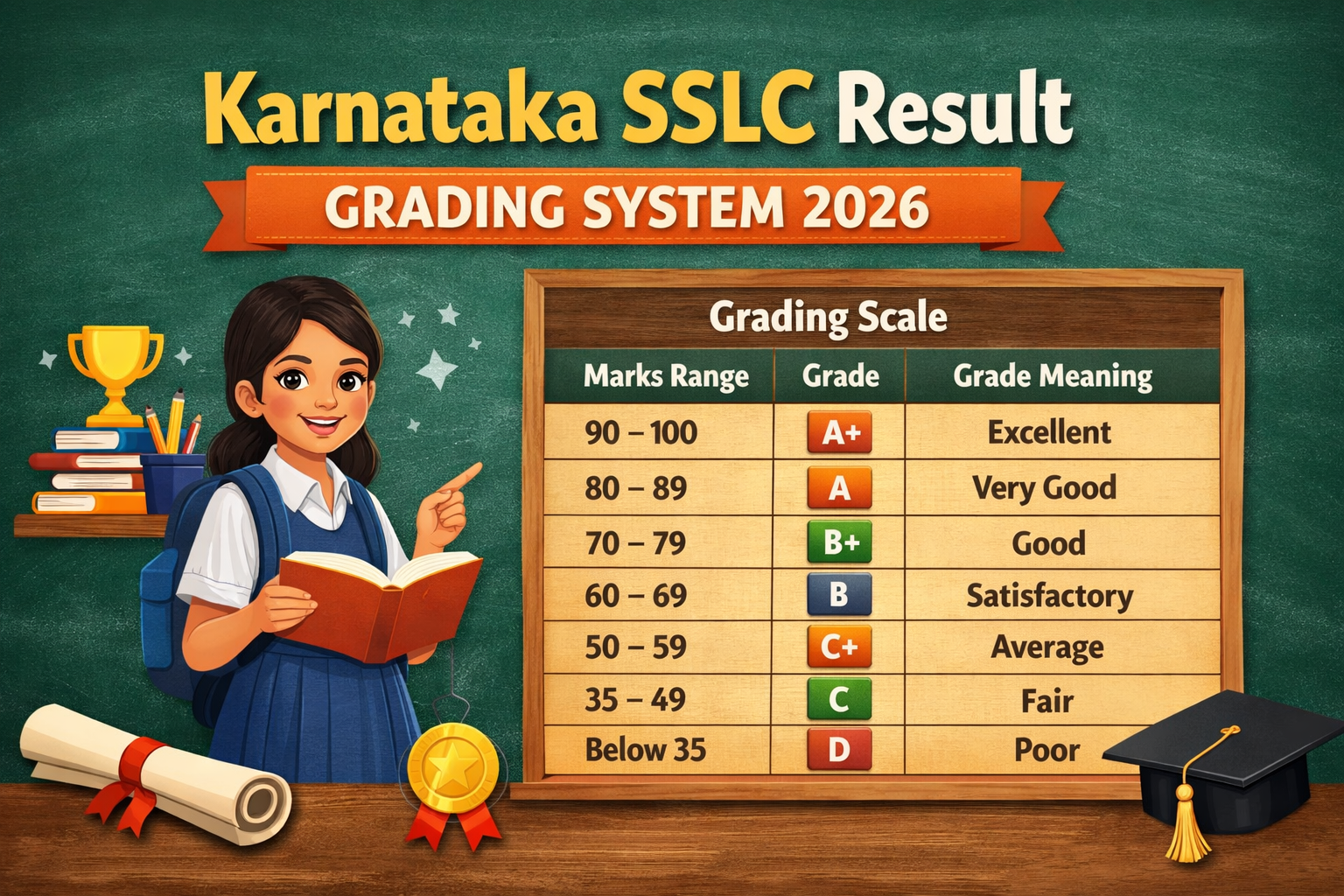
Here’s the official grading scale used by KSEAB:
| Marks Range | Grade | Grade Point | Remarks |
|---|---|---|---|
| 91–100 | A+ | 10 | Outstanding |
| 81–90 | A | 9 | Excellent |
| 71–80 | B+ | 8 | Very Good |
| 61–70 | B | 7 | Good |
| 51–60 | C+ | 6 | Satisfactory |
| 41–50 | C | 5 | Acceptable |
| 35–40 | D | 4 | Basic Pass |
| Below 35 | F | 0 | Fail |
Each student’s final result is calculated by converting their subject-wise marks into grade points and then averaging them. This average determines the student’s overall performance in the Karnataka SSLC result grading system.
Why the Karnataka SSLC Result Grading System Was Introduced
The Karnataka State Board introduced the Karnataka SSLC result grading system to make the evaluation process more student-friendly and reduce the pressure associated with marks.
Here are the main reasons behind its implementation:
- Reduces exam stress: Grades minimize competition and anxiety related to marks.
- Promotes conceptual learning: Encourages students to understand concepts instead of memorizing.
- Ensures fairness: A uniform scale helps avoid inconsistencies in evaluation.
- Improves motivation: Students are motivated to perform better instead of fearing low marks.
- Global relevance: The grading approach aligns with international education systems.
The Karnataka SSLC result grading system helps create a balanced learning environment where students can focus on actual learning rather than just exam results.
Benefits of the Karnataka SSLC Result Grading System
The grading system offers multiple advantages for both students and educators.
1. Fair Evaluation
Every student is evaluated on a common scale, ensuring equal opportunities and transparency in the assessment process.
2. Reduces Pressure
The Karnataka SSLC result grading system prevents students from comparing exact marks, helping them focus on their strengths and areas of improvement.
3. Encourages Holistic Learning
Instead of focusing only on marks, students are evaluated on overall understanding, skill development, and application of knowledge.
4. Promotes Healthy Competition
Grades motivate students to improve their performance gradually rather than feeling disheartened by small mark differences.
5. Aligns with Modern Education
This system matches national and international evaluation trends, making students better prepared for future studies.
How to Calculate Your Grade in the Karnataka SSLC Result Grading System
To find your grade, simply compare your total marks in each subject with the grade chart provided by KSEAB.
Example:
If you scored:
- Mathematics: 88 marks → Grade A (9 points)
- Science: 76 marks → Grade B+ (8 points)
- English: 64 marks → Grade B (7 points)
- Social Science: 93 marks → Grade A+ (10 points)
- Kannada: 82 marks → Grade A (9 points)
Now, the average grade point = (9 + 8 + 7 + 10 + 9) / 5 = 8.6, which corresponds to an A grade overall.
This method gives students a clear and easy-to-understand evaluation of their performance using the Karnataka SSLC result grading system.
Difference Between Marks and Grades in SSLC Results
| Criteria | Marks System | Grading System |
|---|---|---|
| Evaluation | Based on exact marks | Based on performance range |
| Student Pressure | High | Reduced |
| Competition | Encourages unhealthy comparison | Promotes improvement |
| Transparency | Sometimes inconsistent | More transparent |
| Learning Outcome | Focus on memorization | Focus on understanding |
The Karnataka SSLC result grading system emphasizes learning outcomes rather than numeric scores, aligning with the goal of quality education.
How the Karnataka SSLC Result Grading System Helps in Higher Education
The grades awarded under the Karnataka SSLC result grading system are widely accepted for admissions to higher secondary education. Colleges and institutions often convert grades into marks or grade points when preparing merit lists.
For example, students with A+ or A grades are considered highly competent and are given preference during admissions. Additionally, since the grading system aligns with CBSE and other national boards, it ensures smooth academic transitions for students moving between education systems.
Tips for Students to Perform Well Under the Grading System
- Focus on Understanding: Learn concepts deeply rather than memorizing answers.
- Practice Regularly: Revise key chapters frequently to strengthen your understanding.
- Attempt Mock Tests: These simulate the real exam and help you manage time.
- Review Past Papers: Understand recurring patterns and important topics.
- Stay Consistent: Regular study habits always result in better grades.
By following these habits, students can easily aim for A or A+ grades in the Karnataka SSLC result grading system.
Conclusion
The Karnataka SSLC result grading system represents a major shift toward a more student-friendly evaluation approach. It focuses on learning, understanding, and performance consistency rather than the stress of scoring high marks.
With this grading model, students can identify their academic strengths, work on their weaker subjects, and feel more confident about their progress. By understanding how the Karnataka SSLC result grading system works, both students and parents can make informed decisions about preparation and future studies.
Whether you’re checking your results or preparing for the exams, remember: your grade is not just a number; it’s a reflection of hard work, understanding, and growth throughout the year.
If you’re preparing for the upcoming SSLC exams, understanding the Karnataka SSLC result grading system is only one part of your success. The next crucial step is to stay updated with the SSLC Exam Time Table 2026 Karnataka State Board, which outlines all subject-wise exam dates and timings. Knowing your schedule in advance allows you to plan your studies strategically and perform better in each paper. You can check out our detailed guide on the SSLC Exam Time Table 2026 Karnataka State Board to download the full timetable and get expert preparation tips.